Mainnet
…
chain ID
This page starts from zero knowledge. The brief was four words — "use Robinhood Chain" — and nothing else was known: not whether it was real, not whether we could deploy to it, not what it cost, not whether anyone would ever see the result.
What follows is the actual investigation, in the order it happened. Every number below was either measured directly against the chain from our server or read from the official docs, and each one says which.
Queried live in your browser, straight from rpc.mainnet.chain.robinhood.com — no server of ours in the middle. If those read "…" the public RPC is rate-limiting; the numbers in the tables below are from our own measurements and stand on their own.
 The collection
Zoltan on RobinHood
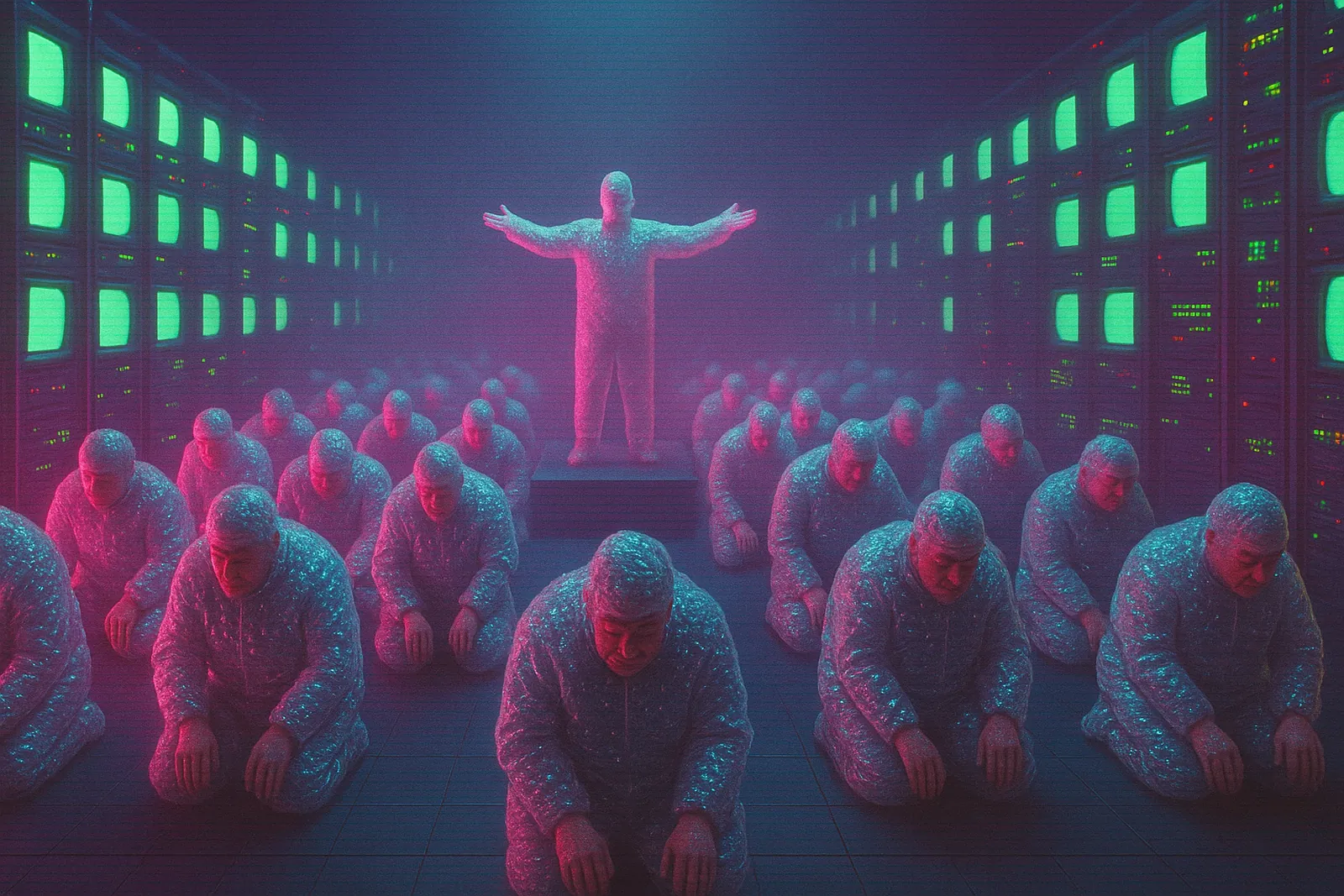
A 1990s hacker-cult on chain 4663 — bubble wrap jumpsuits, a wall of green CRTs, and a very sincere idiot who has read the gas table. See the art and where the collection stands.
Enter the gallery →
The collection
Zoltan on RobinHood
A 1990s hacker-cult on chain 4663 — bubble wrap jumpsuits, a wall of green CRTs, and a very sincere idiot who has read the gas table. See the art and where the collection stands.
Enter the gallery →
Seven things we didn't know, and how each got answered.
Plenty of "chains" are press releases. The fastest way to tell the difference is to stop reading and start knocking: a real chain answers a JSON-RPC call. So the very first thing we did was fire eth_chainId at the documented endpoints from the server.
# from the VPS, no keys, no account, no signup
curl -X POST https://rpc.mainnet.chain.robinhood.com \
  -H 'content-type: application/json' \
  -d '{"jsonrpc":"2.0","id":1,"method":"eth_chainId","params":[]}'

{"jsonrpc":"2.0","id":1,"result":"0x1237"}   ← 0x1237 = 4663
Both networks responded immediately. Mainnet is chain 4663, live since 1 July 2026. Testnet is chain 46630, live since 10 February 2026. Both were reachable from our box on the first try with no credentials — which also told us the public RPCs are genuinely public.
This mattered more than anything else, because everything we've built in crypto so far is Dogecoin — a UTXO chain, with a signing core, a UTXO classifier and an inscription engine written specifically for it. If Robinhood Chain were its own exotic thing, we'd be starting from nothing.
It isn't. Robinhood Chain is an Ethereum Layer 2 built on Arbitrum Orbit (the Nitro stack), settling to Ethereum with blob data availability, using ETH as its gas token, with ~100 ms block times and full EVM compatibility.
We confirmed the Arbitrum lineage ourselves rather than taking the docs' word for it — by calling the ArbGasInfo precompile, a contract that only exists at address 0x…6C on Arbitrum Nitro chains. It answered:
# ArbGasInfo.getPricesInWei() — an Arbitrum-only precompile
perStorageAllocation  863.000000 gwei
perArbGasBase           0.020000 gwei
perArbGasCongestion     0.023150 gwei
perArbGasTotal          0.043150 gwei
A standard ERC-721 works here exactly as it would on Ethereum. That's the good news and the bad news: the entire Dogecoin toolchain (dogewallet-core.js, the UTXO rules, doginals) is irrelevant to this project, and this becomes the first EVM project on the platform. Everything transferable comes from the Ethereum world instead — Solidity, OpenZeppelin, Foundry, MetaMask, OpenSea.
A chain run by a public brokerage could plausibly be permissioned: whitelisted deployers, KYC, an application form. If so, an independent art collection would be dead on arrival.
Contract deployment on Robinhood Chain is open to anyone. No approval, no allowlist, no relationship with Robinhood required. The chain already hosts a growing set of independent NFT collections and community tokens alongside Robinhood's own Stock Tokens. We can ship without asking anybody.
This is the question that kills most Ethereum NFT projects — an L1 collection launch can cost thousands of dollars in gas. We measured it rather than guessing, pulling the live base fee off the chain and multiplying by realistic gas figures.
Base fee measured at 0.04315 gwei. Priority fee is zero. At an ETH price of $1,890, a complete collection launch costs well under a dollar. See the full table below.
The hardest problem with our Dogecoin collections has always been distribution — Doginals live in a small ecosystem with thin marketplace support, so we had to build our own galleries and mint pages for every single collection. If Robinhood Chain NFTs were invisible to the major marketplaces, we'd be doing that all over again.
OpenSea supports Robinhood Chain natively, on both web and mobile. A standard ERC-721 deployed to chain 4663 gets indexed, displayed, listed and traded there without us building any of it. There is also HOODIES, a Robinhood-Chain-native NFT marketplace with self-serve listing. The chain has already seen tens of thousands of mints and secondary sales.
ETH on Ethereum, Base, or anywhere else cannot pay Robinhood Chain gas. The ETH has to physically be on chain 4663. So before a single line of Solidity matters, we need a funded address there.
The trustless route is the canonical Arbitrum bridge (Ethereum → Robinhood Chain, ~10 minutes, you pay Ethereum L1 gas). Faster third-party routes exist — Relay and Across settle in seconds, plus Stargate, Chainlink CCIP and LI.FI/Jumper. Going the other way is slower: withdrawals carry Arbitrum's standard 7-day challenge period. The open item is whether the Robinhood app itself can withdraw ETH straight onto Robinhood Chain, which would skip L1 gas entirely — see open questions.
The platform has never done EVM work. We audited what's installed before assuming anything.
node        v20.19.2   present
npm         missing
forge/cast  missing    (Foundry)
solc        missing    (Solidity compiler)
python web3 missing
disk free   143 GB    plenty
The box has no EVM toolchain at all. The fix is one install: Foundry ships forge, cast and anvil as standalone binaries with no Node dependency, which suits this box far better than a Hardhat/npm setup. That plus OpenZeppelin's audited ERC-721 is the whole build environment.
Base fee 0.04315 gwei measured live off chain 4663 · priority fee 0 · ETH at $1,890.
| Operation | Gas (est.) | Cost in ETH | Cost in USD |
|---|---|---|---|
| Deploy full ERC-721 (OpenZeppelin, enumerable) | 2,800,000 | 0.00012082 | $0.23 |
| Deploy lean ERC-721A (batch-optimised) | 1,800,000 | 0.00007767 | $0.15 |
| One mint | 150,000 | 0.00000647 | $0.012 |
| One transfer / sale | 60,000 | 0.00000259 | $0.005 |
| Deploy + mint an entire 250-piece collection | ~40,300,000 | 0.00173 | $3.29 |
The cost is not the constraint here. Minting a 250-piece collection outright costs about three dollars in gas. For comparison, the equivalent Dogecoin collection work has run to tens of DOGE in inscription fees, and the same collection on Ethereum L1 would be four figures. Fund the deployer with 0.01 ETH (~$19) and there is more than enough headroom for the launch plus years of operations.
Gas figures are standard-contract estimates, not measurements of our contract — we don't have one yet. They'll be replaced with forge's exact numbers, and re-checked on testnet, before anything is deployed to mainnet with real money. The base fee, priority fee and ETH price are measured.
Distribution is solved for us, which changes what we have to build.
This is the sharpest break from how we've done crypto so far. Every Doginal collection needed its own gallery, its own mint page and its own explainer, because nothing else would show them. Here, the marketplace layer already exists — so our own site becomes the story and the mint front door, not the infrastructure of last resort.
Real ETH, on chain 4663, before anything ships.
| Route | Speed | Cost | Notes |
|---|---|---|---|
| Canonical Arbitrum bridge | ~10 min | Ethereum L1 gas | Trustless, security inherited from Ethereum. The default. |
| Relay | seconds | route fee | Bridge-and-execute in one transaction |
| Across | seconds | route fee | Intents-based, capital efficient |
| Stargate / LayerZero | minutes | route fee | OFT transfers |
| Chainlink CCIP | minutes | route fee | Messaging plus token transfer |
| LI.FI / Jumper | seconds–min | route fee | Aggregates the above |
Withdrawing is the slow direction. Getting value back to Ethereum is a three-step exit: initiate on L2, wait the 7-day challenge period that Arbitrum's fraud-proof system requires, then claim on L1 and pay L1 gas. Money that goes in should be money we intend to leave in. Funding 0.01 ETH keeps the amount at stake trivial regardless.
Safety note: if a deposit's L2 leg fails — typically for insufficient gas — the funds are not lost and can be manually redeemed from the bridge interface within 7 days.
What has to happen, in order, to get a collection live.
forge, cast, anvil) plus OpenZeppelin contracts. Standalone binaries, no npm needed. One-time setup on the box.forge test, run against a local anvil fork before it goes anywhere near a network.Step 2 is the only real blocker. Everything else is mechanical work we can now cost, schedule and execute with confidence. What the collection actually is — the art, the size, the idea — is yours to call.
Honest list of what we still don't know.
Can ETH be withdrawn from the Robinhood app straight onto Robinhood Chain, skipping Ethereum L1 gas entirely? The chain docs don't address it. Given the account already exists, this is worth ten minutes of checking before we pay to bridge.
The cost table uses standard-contract estimates. Real numbers come from forge once the contract exists — though at $0.23 the estimate would have to be wrong by 100× to matter.
ERC-2981 sets a royalty on-chain, but whether it's honoured depends on the marketplace. Needs confirming for OpenSea on this chain specifically.
Serving metadata from this box is free and instant, but ties the collection's images to our uptime. IPFS or Arweave is the alternative. A judgement call tied to how permanent the collection is meant to be.
| Mainnet | Testnet | |
|---|---|---|
| Chain ID | 4663 | 46630 |
| RPC | rpc.mainnet.chain.robinhood.com | rpc.testnet.chain.robinhood.com |
| WebSocket | wss://feed.mainnet.chain.robinhood.com | wss://feed.testnet.chain.robinhood.com |
| Sequencer | sequencer.mainnet.chain.robinhood.com | sequencer.testnet.chain.robinhood.com |
| Explorer | robinhoodchain.blockscout.com | explorer.testnet.chain.robinhood.com |
| Gas token | ETH | ETH |
| Live since | 1 July 2026 | 10 February 2026 |
Stack: Arbitrum Orbit / Nitro · settles to Ethereum · blob data availability · ~100 ms blocks · fully EVM-compatible · permissionless deployment. Public RPCs are rate-limited and explicitly not for production; Alchemy is the recommended production provider. Docs: docs.robinhood.com/chain.